AI Strategy Consultant vs AI Implementation Partner: Who to Hire First
Gartner expected 30% of generative AI projects to be abandoned after proof of concept by the end of 2025. If you can only buy one supplier first, buy the build, scoped narrow, and write the strategy from what it measures.
By Ivan Pylypchuk, CEO of SoftBlues. Has led Claude and Gemini implementations for finance, legal and healthcare teams across the UK and Ireland.
Gartner put a number on the thing every board already suspects: at least 30% of generative AI projects would be abandoned after proof of concept by the end of 2025, on poor data quality, weak risk controls, escalating costs or unclear business value (Gartner, July 2024). Both halves of the AI supplier market claim to be the fix. An AI strategy consultant sells you the thinking that stops you building the wrong thing. An AI implementation partner sells you the thing itself. If you can only buy one first, buy the implementation, scoped deliberately narrow, and let the strategy be written from what it teaches you.
At SoftBlues, an AI consultancy working with regulated mid-market companies across the UK and Ireland, we do both jobs, which means we usually meet a company after it has bought one of them and is unhappy with the result.
The evidence for going implementation-first is uncomfortable for our own industry. The single most common reason UK businesses give for not adopting AI is that they have not identified a use for it (71%), with limited AI skills second at 60% (DSIT AI Adoption Research, 3,500 UK businesses, published 2025). That looks like a strategy problem. It is usually an evidence problem. Companies do not lack ideas about AI; they lack a single case where they have watched it work on their own data, with their own staff, and can therefore say what the second one should be.
Key facts
Who this is for, and who it isn't
This is for the CEO, CTO or COO of a 50 to 500 person company in the UK or Ireland who has budget approved, a process that visibly hurts, and two suppliers in the inbox proposing very different first steps.
It is not for enterprises with an existing AI function and a portfolio to govern. Your sequencing question is about prioritisation, not about which supplier to call. It is also not for companies who have not yet named a process they would like to be cheaper or faster. Name that first; both suppliers are guessing without it.
What does an AI strategy consultant actually hand over?
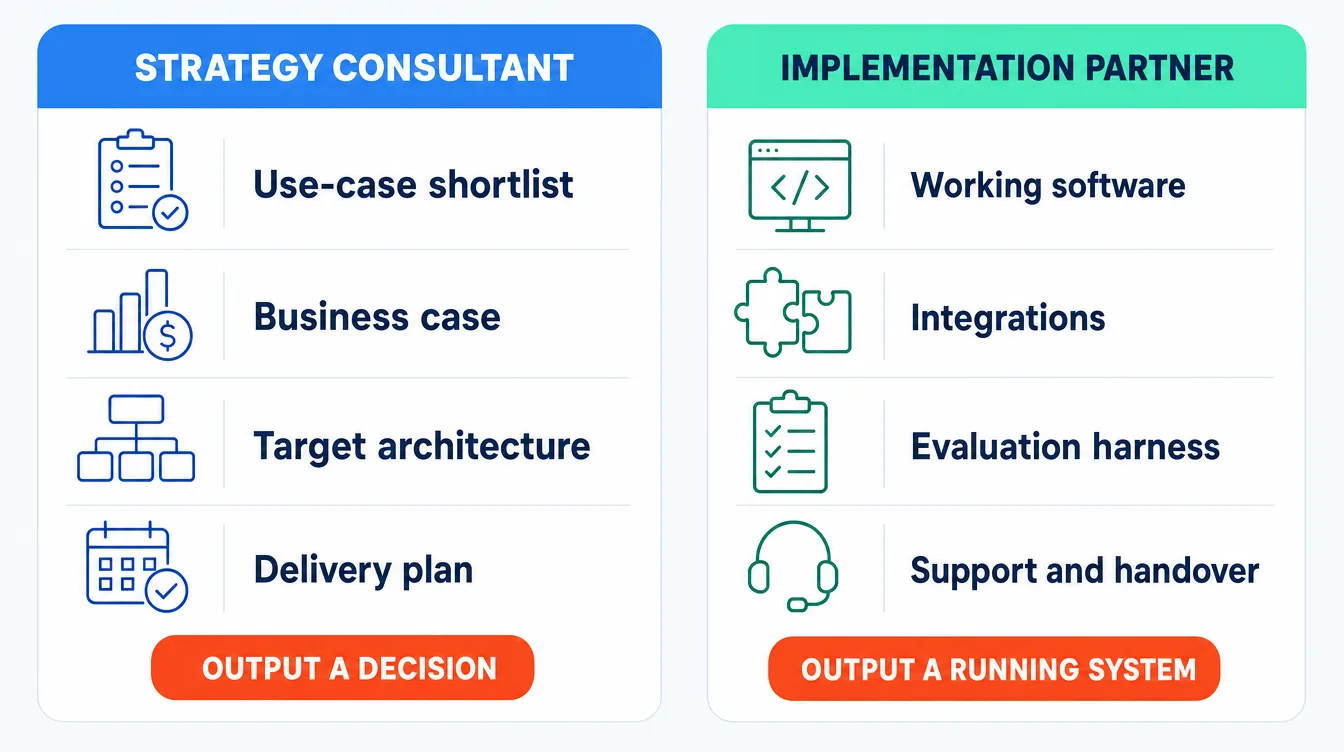
A strategy engagement produces documents, and the good ones are worth having. Expect a shortlist of candidate use cases scored on value and feasibility, a data and readiness assessment that tells you honestly what your systems can and cannot support, a target architecture, a business case with named owners and numbers, and a delivery plan with a sequence. Typical length is two to six weeks.
The judgement you are buying is negative as much as positive: a good consultant tells you which four of your six ideas are not worth building this year. We break down the artefacts and the pricing in more detail in our guide to what AI strategy consulting should get you for your money.
What you do not get is anything that runs. That matters more than it sounds, because a plan written without a build behind it rests on assumptions about your data quality, your staff's tolerance for a new tool, and how long a model actually takes on your documents. Those three assumptions are where most AI business cases go wrong.
What does an AI implementation partner actually hand over?
An implementation partner produces working software and the machinery around it: the integrations into your existing systems, an evaluation harness that proves the thing does what it claims on your real cases, access controls and audit logging, staff training, and a support arrangement. Typical length for a first narrow build is six to twelve weeks.
The judgement you are buying here is about scope: what is the smallest slice of a real process that can go live and be measured. A partner who agrees to build everything in the request is not being helpful.
The honest weakness of implementation-first is that a partner with no strategic view will build what you asked for, ship it, and leave you with one good tool and no idea what the second should be. That is a real risk and it is why the sequencing below ends where it does.
Not sure which half you are actually shopping for? A 30-minute discovery call is usually enough to tell. We will walk through the process you want fixed, say plainly whether it needs a plan or a build first, and give you a rough shape and cost either way, including if the answer is that you do not need us yet. Book a discovery call.
AI strategy consultant vs AI implementation partner: the side-by-side
| AI strategy consultant | AI implementation partner | |
|---|---|---|
| What you receive | Use-case shortlist, readiness assessment, business case, roadmap | Deployed system, integrations, evals, training, support |
| Typical duration | 2–6 weeks | 6–12 weeks for a first narrow build |
| How it's priced | Day rate or fixed-fee discovery | Fixed-price project or monthly build retainer |
| Who signs it off | CEO, CFO, board | CTO, Head of Operations, Head of IT |
| Evidence produced | Analysis of what should work | Measured results from what does |
| Best for | Regulated launches, multi-entity rollouts, board budget gates | One painful process, budget approved, appetite to move |
| Avoid if | You already know the process to fix | Nobody can name the process to fix |
| Fails by | Producing a plan nobody can implement | Building the wrong thing competently |
So who do you hire first?
For most UK and Irish mid-market companies the answer is implementation, deliberately scoped small, and then strategy written from the evidence it produces.
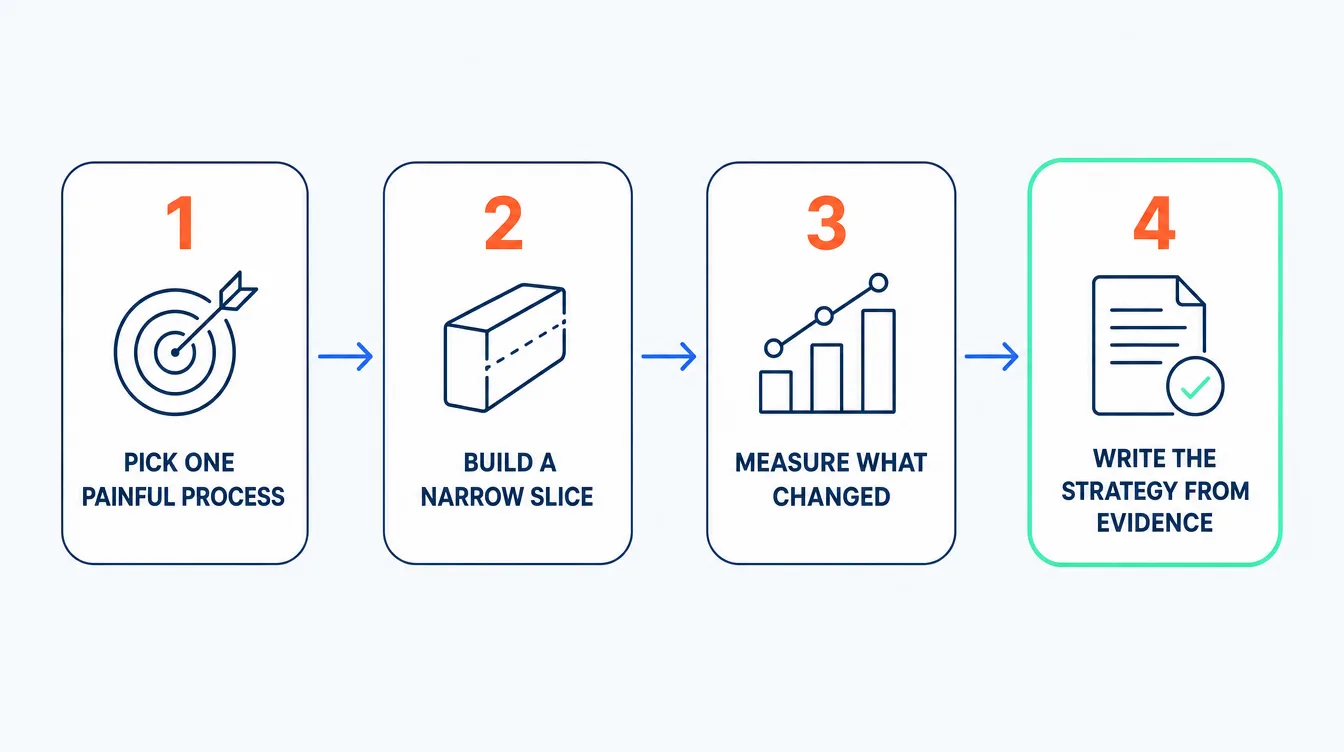
1. Pick one painful process. Not the most strategically interesting one. Pick the one where staff already complain about the time it takes and where you can count the hours. Invoice coding, first-line support triage, file review, quote preparation.
2. Build a narrow slice of it. One document type, one team, one workflow, running against live data with a human still in the loop. Six to twelve weeks, fixed price, with an evaluation harness so "it works" is a measurement and not an opinion.
3. Measure what actually changed. Handling time before and after, error rate, how many cases the system handled unaided, how many staff kept using it in week eight. This is the data your business case has been missing. Our framework for measuring the return on an AI implementation covers what to instrument before you start.
4. Then write the strategy. Now the roadmap is grounded: you know your real data quality, your real integration cost, and your team's real adoption curve. A plan built on those three numbers survives contact with the second use case. One built on benchmarks does not.
We ran this on ourselves before recommending it. We use it before we sell it. Six SoftBlues departments now run day to day on Claude, and the sequence was the same: one function first, measured, then the next. The write-up is our Claude operating system case study.
When you should hire strategy first anyway
Three situations invert the order, and they are not rare.
A regulated launch where the risk position must exist before the data moves. In financial services, healthcare and legal work, your DPIA, lawful basis, model risk assessment and retention position are not paperwork that follows the build. They decide what the build is allowed to touch. Getting that wrong is expensive in a way a rebuild is not.
A genuine multi-entity or multi-site rollout. If the same process runs differently in five offices or three acquired companies, a narrow build in one of them teaches you less than it appears to. Map the variation first.
A board that will not release build budget without a costed plan. This is a governance fact, not a technical one, and arguing with it wastes a quarter. Buy a short, fixed-fee discovery rather than an open-ended advisory retainer, and make its deliverable a build specification you can put out to tender.
When you need both in one firm
If your timeline is a single quarter, splitting the two across suppliers usually costs you more than it saves. The handover is where the loss happens: the builder inherits a specification they did not write, cannot interrogate the assumptions in it, and re-does a fortnight of discovery inside a build budget.
One firm doing both is worth it when the diagnosis and the build need to happen inside twelve weeks, when the same people who scoped it will be accountable for the number it produces, and when nobody wants an argument about whose fault it is if the results disappoint. The trade-off is honest: you lose the independence of a supplier with nothing to sell you at the end. Ask for a fixed-scope discovery whose deliverable is a costed plan you are free to take elsewhere. Any firm confident in its delivery will agree.
If you are choosing between firm types rather than sequencing, we compare the categories directly in AI consulting firms vs AI development companies, and the pilot-to-production path is set out in our AI implementation roadmap for UK companies.
How each engagement fails, and the early warning signs
Strategy failure looks like a deck arriving on time. The warning signs come earlier: nobody on the consultant's team has shipped a production AI system; the proposal has no technical validation step; the use-case scoring uses industry benchmarks rather than your numbers; the plan's first milestone is another workshop. By week three, if you have not been asked for a data sample, the analysis is generic.
Implementation failure looks like a demo that works. The warning signs: no evaluation harness, so quality is judged by eye; no baseline captured before the build, so improvement cannot be proved; the scope grew twice in the first month; the pilot runs on exported data rather than a live integration, which quietly defers the hard part. If nobody has told you what the system will refuse to do, it has no boundary and will fail in production on the cases nobody defined.
Questions to ask on the call, and what a good answer sounds like
1. What will exist at the end that does not exist now? Good answer: a specific artefact or a specific running workflow, named. Bad answer: "clarity", "alignment", "a roadmap".
2. What is the smallest version of this we could do first? Good answer: a concrete narrower scope, offered without prompting, and a lower price attached to it. Bad answer: an argument for why the full scope is necessary.
3. How will we know it worked? Good answer: a metric, a baseline measurement taken before the build, and a threshold. Bad answer: a satisfaction survey.
4. Who exactly does the work? Good answer: named people, with the systems they have shipped. Bad answer: "our delivery team".
5. What happens to this if we change our mind in week five? Good answer: a stated change process and what it costs. Bad answer: reassurance.
6. What would make you tell us not to do this? Good answer: two or three concrete disqualifiers. Bad answer: none.
Frequently asked questions
What is the difference between an AI strategy consultant and an AI implementation partner? A strategy consultant analyses and recommends: their deliverable is a decision, expressed as a use-case shortlist, business case and roadmap. An implementation partner builds and runs: their deliverable is working software integrated into your systems, with evaluations, training and support.
Should I hire an AI strategy consultant before an implementation partner? Usually no. For a mid-market company with one clearly painful process, a narrow implementation first produces the measured evidence a strategy needs. Hire strategy first if you face a regulated launch, a multi-entity rollout, or a board budget gate that requires a costed plan.
How much does each cost in the UK? Strategy work is priced as a day rate or a fixed-fee discovery; implementation as a fixed-price project or a monthly build retainer. Our own bands are £10,000 to £20,000 for a fixed-scope discovery and £10,000 to £20,000 per month for an implementation retainer (August 2026). Market-wide ranges are in our guide to AI consulting costs in the UK.
Can one firm do both without a conflict of interest? It can, but the incentive is real: a firm that builds has a reason to recommend building. Manage it by buying the discovery as a fixed-scope piece whose deliverable is a specification you own and are free to tender elsewhere.
How long before we see a result? For a narrow first build, six to twelve weeks to something live and measured. A strategy engagement produces its deliverable in two to six weeks, but the result, a change in a business number, only arrives after the build that follows it.
What if we do not know which process to start with? That is the one case where a short discovery earns its fee immediately. It should take two to three weeks and end with a ranked shortlist and a costed first build, not with a longer advisory engagement.
Does this change for regulated industries? The sequence holds, but the first step gets a compliance gate in front of it: data protection impact assessment, lawful basis, model risk position and retention rules agreed before any production data is touched. That is strategy work, and in regulated sectors it is not optional.
SoftBlues is a registered member of the Anthropic Partner Network and a Google Cloud partner, working with UK and Ireland mid-market companies in regulated sectors. We do the diagnosis and the build, and we would rather scope you a small first project than a large first document.
If you want a straight answer on whether your next step is a plan or a build, book a discovery call.
See it in production
Systems we have built and run for clients, with the numbers that came out of them.
Related Articles
Claude Enterprise vs Team vs Pro: Which Plan Does Your Business Need?
Gemini for Business vs Claude Enterprise: Which Fits Your Company in 2026?