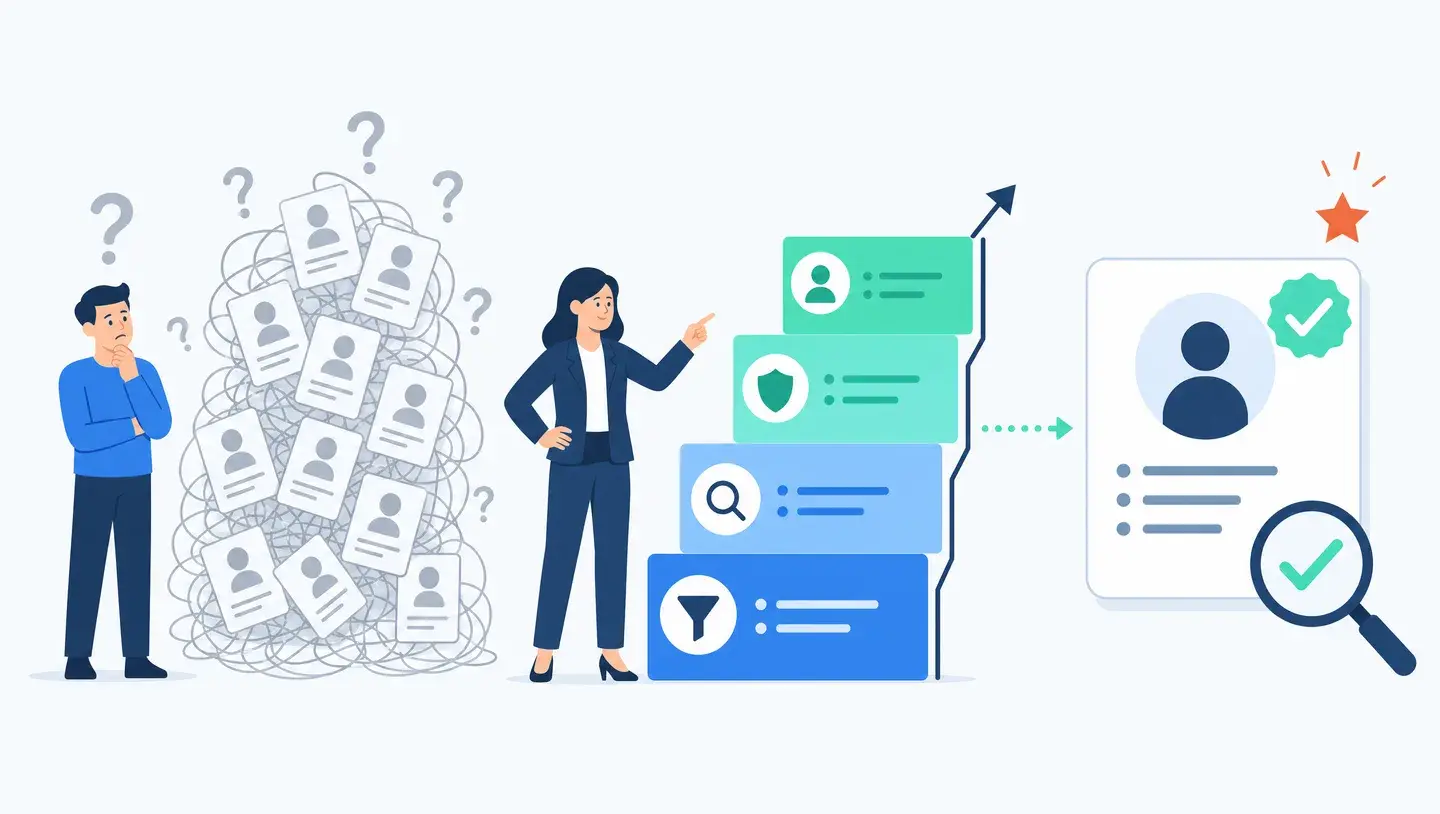
AI Consulting for SMEs and Mid-Market Companies: What Changes Below Enterprise Scale
54% of UK firms now use AI, but only about one in ten SMEs has moved past generic tools. Here is what changes when you buy AI consulting below enterprise scale: budgets, data, and where to start.
By Ivan Pylypchuk, CEO of SoftBlues. Has led Claude and automation implementations for finance, legal and professional-services teams across the UK and Ireland.
AI consulting for SMEs and mid-market companies means scoping one costly process, proving its payback, and shipping it into production. It is not a company-wide AI strategy programme. Below enterprise scale there is no ML team and no appetite for a nine-month roadmap, so the work starts at the process and the budget is measured against one line of cost.
More than half of UK firms, 54%, are now actively using AI, up from 35% a year earlier and 23% in 2023 (British Chambers of Commerce and Atos, March 2026). Around 94% of the firms in that survey were SMEs. The same research found something more useful than the headline: only about one in ten SMEs has moved past generic tools into bespoke AI built around their own processes. At SoftBlues, an AI consulting firm working with regulated mid-market companies across the UK and Ireland, most of the enquiries we take come from firms sitting in the other 90%, using ChatGPT informally and wondering what the next step costs.
Key facts
Who this is for: an operations, finance or IT leader at a 50 to 500-person UK or Irish company, most often in finance, legal, healthcare or professional services, who has a specific process that costs too much and wants to know what fixing it involves.
Who this is not for: a solo founder wanting a weekend prototype, a startup looking for a technical co-founder, or a FTSE 250 team with a data platform and in-house ML engineers already in place. The first two are better served by off-the-shelf tools. The third does not need what this article describes.
What actually changes below enterprise scale?
Four things change, and each one makes the engagement smaller and faster rather than a cheaper copy of the enterprise version.
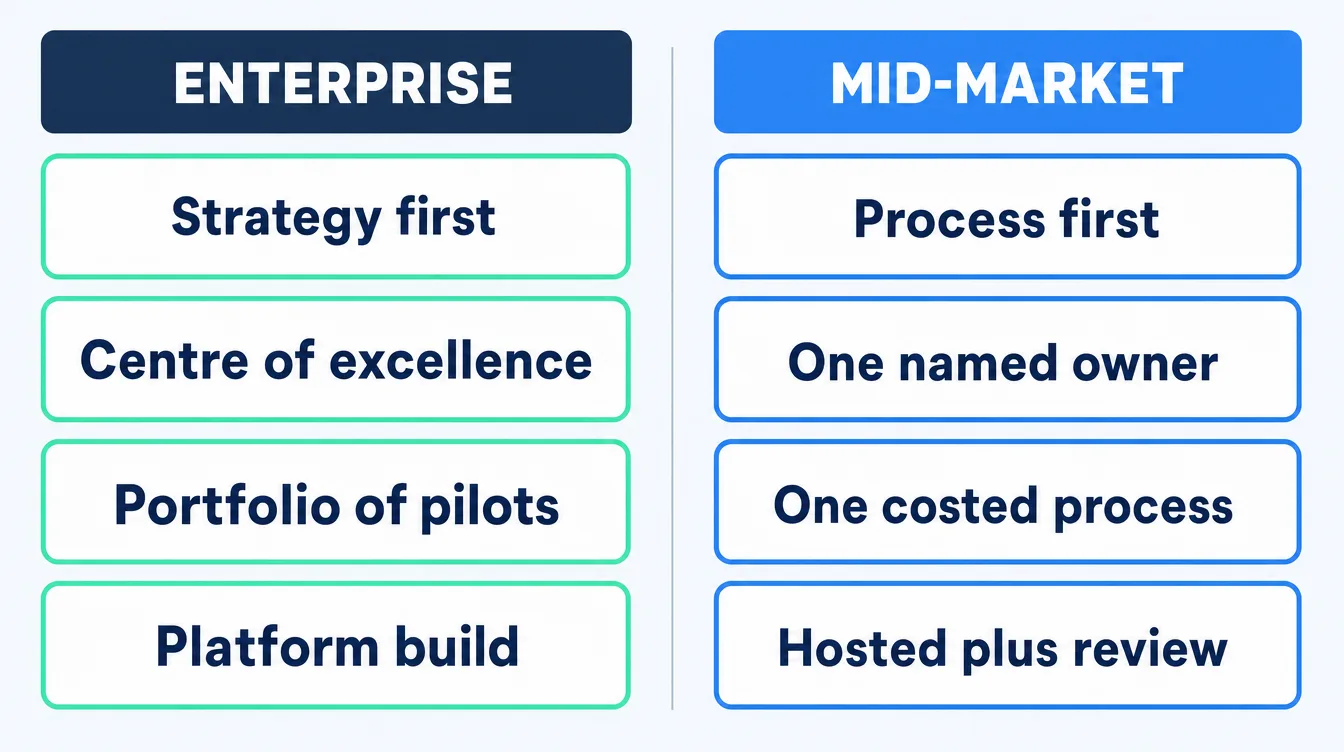
1. There is no ML team to hand the work to. An enterprise consultancy can design a system and leave it with an internal platform group. A 120-person firm has an IT manager, a finance system and a busy operations lead. Whatever gets built has to run without a specialist babysitting it. That rules out most bespoke model training and pushes the work toward hosted models and deterministic integrations with explicit human review points.
2. The budget is compared against a person, not a programme. Enterprise AI budgets get compared against other technology budgets. Mid-market budgets get compared against a salary. If the process you are automating consumes two full-time equivalents, the honest test is whether the build plus its running cost comes in under that, and how quickly.
3. Data is messy but small. This is the most under-appreciated advantage of the mid-market. A 200-person firm's ten years of contracts, invoices or case files usually sit in three or four systems, not thirty. That is a weekend of mapping, not a governance programme. The scoping question is not whether the data is clean. It is whether the data is findable and structured consistently enough to act on.
4. One person can say yes. Enterprise procurement adds months. In the mid-market a CEO, COO or finance director can approve a discovery in a week. That speed is a real advantage, and it is also why bad projects start: nobody forced the process question first.
What does enterprise AI advice get wrong at this scale?
Most published AI guidance is written for organisations with a hundred times your headcount. Three of its standard recommendations actively cost mid-market firms money.
"Start with an AI strategy." A strategy document is the right first deliverable when you have forty candidate use cases across twelve business units. With four candidates and one operations team, a strategy phase is an expensive way to delay the only question that matters: whether process A pays back faster than process B. We have watched firms spend a discovery budget on a roadmap and end up with nothing to build.
"Set up an AI centre of excellence." At 500-plus staff this creates useful gravity. At 150 it creates a committee that meets fortnightly and owns nothing. Mid-market firms need one named owner per automated process and a written rule for when a human has to sign off.
"Run a portfolio of pilots and see what sticks." This is where the widely reported failure numbers come from. MIT's Project NANDA research found roughly 95% of generative AI pilots produced no measurable P&L impact (Forbes, August 2025), and we unpacked that pattern in where automation actually pays back for mid-market operations. A portfolio approach assumes you can afford several misses. Below enterprise scale you can afford one project, so it needs to be the one with a countable cost attached.
Not sure which process to point this at?
A process discovery puts numbers on one workflow before anyone writes code: what it costs you now, what it would cost automated, and what the payback period looks like. It is the cheapest way to find out whether the project is worth running at all.
What does AI consulting cost for an SME or mid-market company?
Two published bands cover most of what we do, and both are sized so a mid-market firm can fund them from an operational budget rather than a capital case.
| Stage | Band | What it buys | Avoid if |
|---|---|---|---|
| Process discovery | £10,000 to £20,000 (our data) | One process mapped end to end, current cost quantified, target design, integration list, payback model and a fixed build quote | You already have a costed process map and a signed-off design |
| Implementation retainer | £10,000 to £20,000 per month (our data) | A working system built, integrated and put into production, with the team available for changes as it beds in | You want a one-off handover with no support window |
| Ongoing running cost | Model, hosting and support, quoted per process (our data) | Keeping it live. This is the line SMEs most often forget to budget for | Nobody internally owns the process after go-live |
Two honest caveats. The discovery band buys a decision, not a system, and it should end with a number you are free to refuse. And the running cost is exactly why 40% of SMEs name maintenance as their top barrier (OECD, December 2025), so ask for it in writing before you sign the build. For a wider comparison of day rates, fixed-price projects and engagement models across the UK market, we broke the structures down in what AI consulting actually costs in the UK.
What does the timeline look like?
| Phase | Typical duration (our data) | What comes out of it |
|---|---|---|
| Process discovery | 2 to 4 weeks | Costed process map, target design, fixed build quote |
| Build and integration | 4 to 8 weeks | Working system against your live systems, with review points |
| Proof and go-live | 2 to 4 weeks | Running in production with a named owner and a measured baseline |
We work fixed-price with money back if the proof of concept fails, and we aim to have a process in production within 90 days. That shape exists because the mid-market cannot absorb a project that runs long.
Which three processes pay back first?
Across the enquiries and engagements we see, three patterns come up far more often than the rest. Each is a back-office process with a countable cost, which is what makes it fundable.
1. Structured intake from unstructured input. Orders, referrals, applications or bookings arriving as email, PDF and phone messages, then being retyped into a scheduling or ERP system. The cost is measurable in hours and in error rework. This is the shape of our order-to-schedule automation for a secure logistics operator, which is a scoped proposal rather than a live deployment, and it is the most common mid-market starting point we see.
2. Recurring file or compliance review. A regulated firm reviewing a sample of client files every month against a checklist. The work repeats, the checklist is already written down, and the output is a documented judgement with a human sign-off. That is the right pattern where a regulator is involved.
3. Internal knowledge retrieval. Staff hunting through SharePoint, a shared drive and Slack for the current version of a policy. Lower risk than the first two and usually faster to ship, though the payback is diffuse rather than a line on a budget.
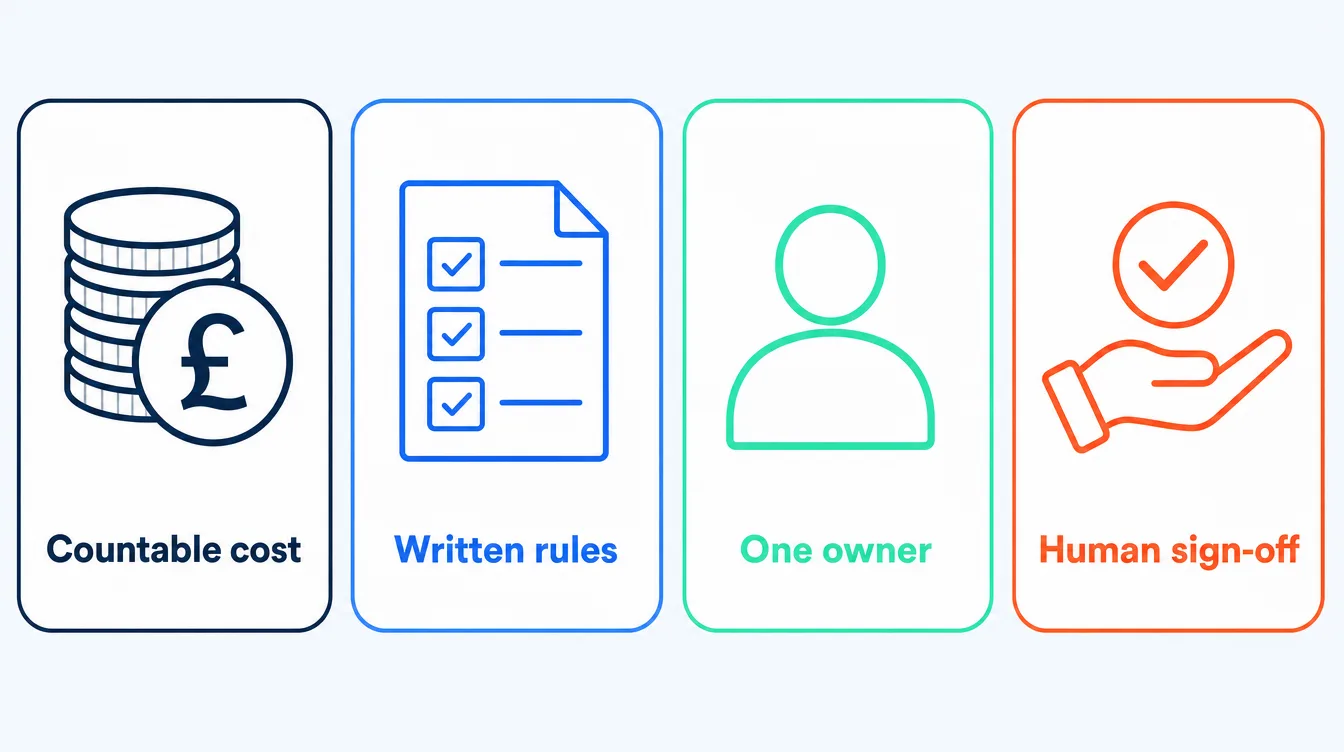
What these share matters more than the list. Each has a countable current cost, a written rule set, a clear owner, and a natural place for a human to approve the output. If a candidate process fails any of those four tests, it is not the one to start with. For a broader menu, see 12 enterprise AI use cases mid-market companies are deploying in 2026.
What are the red flags when a supplier is selling you enterprise scope?
Four things to listen for on the call.
If the discovery produces a roadmap instead of a build quote, ask whether you will hold a fixed price for building one thing at the end of it. A phased programme is enterprise process in mid-market clothing.
If the first hour is about which model rather than which process and what it costs you today, the sequencing is wrong. Model choice is close to a commodity decision at this scale.
If there is no named human review point, be careful. Every regulated workflow needs an explicit answer to who signs off and what they see.
If running cost and ownership go unmentioned, ask what this costs per month once live and who internally has to own it. A good answer gives you both a number and a person.
Frequently asked questions
Is AI consulting worth it for a company with under 100 staff?
It depends entirely on whether one process has a countable cost attached. If you can name a workflow consuming one or more full-time equivalents, the numbers usually work at this scale. If the ambition is general productivity improvement, off-the-shelf tools and internal training will get you further for less.
How is AI consulting for SMEs different from enterprise AI consulting?
The engagement is narrower and shorter. Enterprise work typically starts with a strategy and an operating model spanning many business units. SME and mid-market work starts with one process, one cost figure and one production deadline, because there is no internal platform team to absorb a longer programme.
Do we need clean data before we start?
No, but you need findable data. Most mid-market firms keep their records across three or four systems, which is workable. The scoping question is whether the information the process depends on is structured consistently enough to act on, and that gets answered during discovery rather than assumed.
How long does a first project take?
We work to production within 90 days for a single process, with discovery ahead of that. Longer timelines at this scale usually mean the scope drifted beyond one process, which is the most common reason mid-market AI projects stall.
Should we hire someone instead of using a consultancy?
If you expect a steady pipeline of AI work over several years, an internal hire eventually costs less. For one or two processes it rarely does, because you are also buying integration and delivery experience a first hire will not have. We compared the options in our breakdown of consultant, consultancy or in-house hire.
What happens if the proof of concept does not work?
Ours is fixed-price with money back if the proof of concept fails. Whoever you use, get the failure terms in writing before the build starts, and be wary of an answer that treats failure as impossible.
Which industries does this apply to?
We work mainly with UK and Irish finance, legal, healthcare and professional-services firms with 50-plus knowledge workers. The pattern generalises to any document-heavy operation with a written rule set, though regulated sectors tend to get the most value because their processes are already documented.
SoftBlues is a registered member of the Anthropic Partner Network and a registered Google Cloud partner, and we run six of our own departments on Claude. We use it before we sell it. If you want to see the shape of the work, our business process automation practice sets out how we scope and build.
If you have a process in mind and want a straight answer on whether it pays back, book a discovery call.
See it in production
Systems we have built and run for clients, with the numbers that came out of them.
Related Articles
Claude Enterprise vs Team vs Pro: Which Plan Does Your Business Need?
Gemini for Business vs Claude Enterprise: Which Fits Your Company in 2026?