AI Automation Pricing UK 2026: What Providers Actually Charge
Gartner expects inference cost per agentic workflow to rise more than fivefold through 2028. The quote covers the build; the running cost is the part that moves. Here is what AI automation actually costs in the UK in 2026.
By Ivan Pylypchuk, CEO of SoftBlues. Prices AI automation work for finance, legal and operations teams across the UK and Ireland.
Routing a single task to an agentic reasoning model costs at least five times more per run than putting the same task through a basic chatbot, and Gartner expects inference cost per agentic workflow to rise more than fivefold through 2028 (Gartner, Aug 2026). That one fact explains why AI automation quotes are so hard to compare. The number you are given covers the build, and the build is the only part of the bill that stops growing.
What follows is a set of real price ranges for the four kinds of automation UK mid-market companies actually buy, traced to a rate card rather than pulled from the air, plus what moves those numbers and what you will still be paying in year three.
Key facts
What does AI automation cost in the UK in 2026?
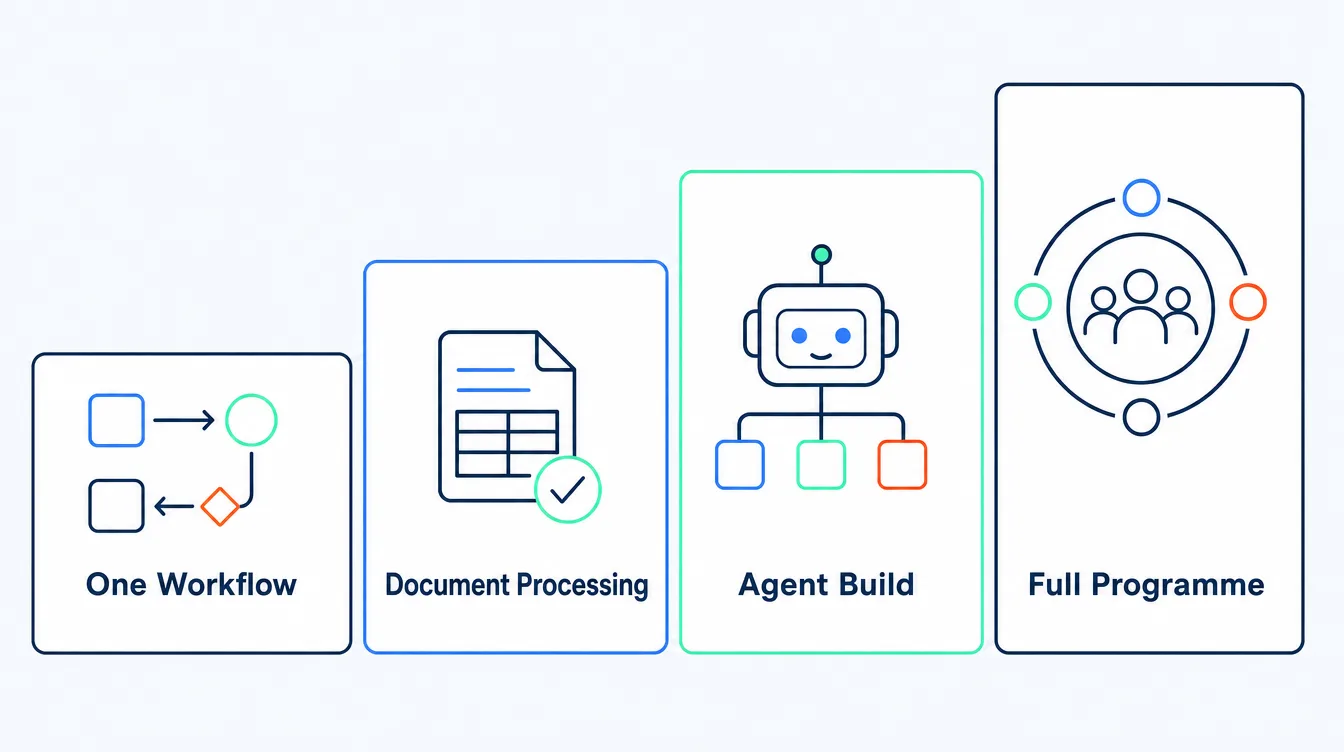
Below is what each type of automation costs, built from day rates and the team shape each job actually needs rather than a headline "starting from" figure. Our engineering rates come from the SoftBlues rate card: £315 a day for an AI engineer, £415 for a senior AI engineer, £315 for a project manager, £155 for QA. The ranges are the honest spread we quote internally, and the shape column tells you why.
| Automation type | Typical shape | Indicative UK price |
|---|---|---|
| Single workflow automation (one process, one or two systems) | 1 AI engineer for 4 to 6 weeks, part-time senior review and PM | £10,000 to £18,000 |
| Document processing (extract, validate, post) | 1 AI engineer for 6 to 8 weeks, plus senior review and QA | £15,000 to £25,000 |
| Fixed-price proof of concept (prove feasibility before committing) | 1 to 2 engineers plus part-time support, 2 months | £20,000 |
| Integration layer (per connected system, bidirectional) | 1 engineer for 2 to 4 weeks per system | £4,000 to £10,000 per system |
| Agent build (multi-step reasoning, tool use, human sign-off) | 2 AI engineers, senior architect, QA and PM, 3 to 4 months | £50,000 to £90,000 |
| Full programme to production (proof of concept through to live) | team scales from 2 to 5 or 6 people across 12 months | around £320,000 |
| Run-and-improve retainer (after go-live) | ongoing engineering, monitoring and oversight | £10,000 to £20,000 a month |
Two of those rows need a footnote. The £20,000 proof of concept is a real published price rather than a loss-leader: two months of work, a working prototype, the technical documentation, and a straight recommendation on whether to go further. The £320,000 twelve-month programme is what a full build genuinely costs when a team scales from two engineers to six and runs through proof of concept, beta and production. Most companies never buy that. They buy the first row, prove it, then buy the fourth.
What drives the price up, and what pulls it down?
Same process, two companies, and a threefold difference in quote. The variables that cause it, in rough order of impact:
1. How many systems you are touching. One system is a project. Four systems, two of which have no usable API, is a different project. Integration is the single most reliable predictor of cost, which is why we price it per system.
2. Whether your data is usable today. If the documents are clean PDFs in one place, extraction is a week. If they are scans of scans across three shared drives with no naming convention, the data work is longer than the build. Nobody can quote this without looking.
3. How much the output has to be trusted. An automation that drafts something for a human to approve is cheap. An automation that posts to a ledger or files with a regulator needs validation layers, audit trails and a rollback path. In regulated work that governance layer is routinely the largest single line in our own scopes.
4. Whether it reasons or just routes. A rules-based workflow is deterministic and cheap to run. An agent that reasons over each case costs more to build and, per the Gartner figure above, materially more to run every month.
5. How many people have to change how they work. The engineering is usually the easy part. Retraining a twenty-person team, rewriting the procedure, and running the old and new process side by side for a month is a real cost that rarely appears on a quote.
6. Fixed price or day rate. A day rate transfers scope risk to you. A fixed price transfers it to the provider, who then prices that risk in. Fixed price usually looks more expensive and usually costs less.
Where the money actually goes after go-live
This is the part that catches people, and it is why Gartner puts budget overruns at half of all generative AI projects. The quote covers the build. The three-year cost includes everything the quote did not mention.
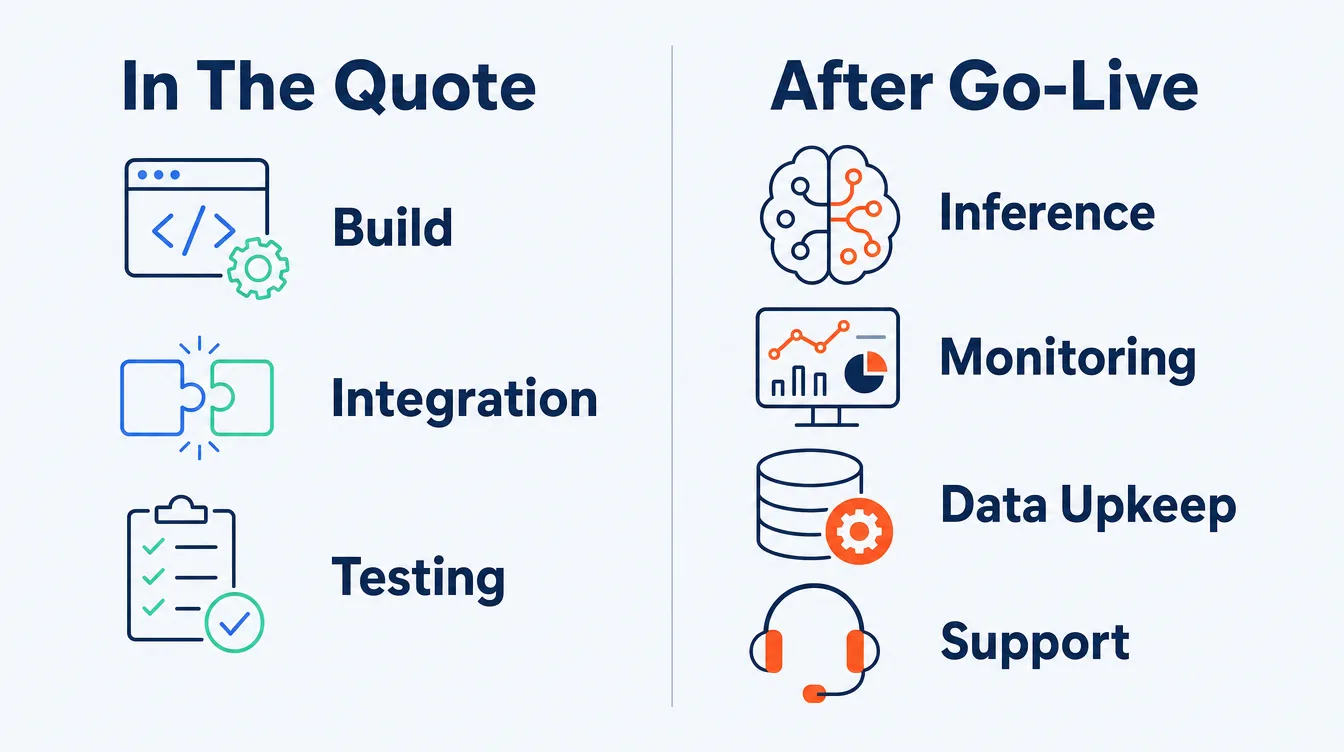
The recurring lines, in the order they tend to surprise people:
We put full numbers on this in what UK mid-market companies actually spend on AI over its life. If your business case only counts the build, you have costed the demo.
Build or buy: the thresholds that decide it
Not every process should be a custom build. The thresholds we use:
Buy off the shelf when the process is standard across your industry, a tool already exists that covers 80% of it, and your differentiator is not in that process. Paying a few hundred pounds a month for a tool beats a £15,000 build every time here.
Build custom when the process is genuinely yours, the data is sensitive enough that you want it inside your own boundary, or the off-the-shelf tools each cover a different 60% and stitching four of them together costs more than one purpose-built workflow.
Do neither yet when you cannot say what the process costs you today. Automating a process you have not measured produces an automated version of a bad process.
The full decision framework, including the volume thresholds where a build starts paying back, is in our build versus buy guide for UK mid-market companies.
You can see how this plays out on real scopes. In an order-to-schedule automation we scoped for a secure logistics operator, the cost sat almost entirely in reconciling order data across systems rather than in the model. In a monthly compliance file review for a financial advice firm, the governance and evidence trail was the expensive part, because a regulated review cannot simply be trusted to run unattended. Both are scoped engagements rather than long-running deployments, and we describe them that way deliberately.
What a fair quote looks like
Six things a serious automation quote contains. If three or more are missing, ask again before signing.
1. The process, named. Not "invoice automation" but "supplier invoices arriving by email, matched to purchase orders in Sage, exceptions routed to the finance inbox".
2. A system-by-system integration list. With a note on which ones have an API and which need a workaround.
3. A fixed price for a bounded first phase. With what happens if the phase runs long, in writing.
4. An estimated monthly running cost. Inference, hosting and support, at your stated volume, with the volume stated.
5. A named accountability path. Who reviews the output, how errors surface, and what the rollback is.
6. An exit. What you keep if you stop after phase one. Code, prompts, documentation and data should all be yours.
How SoftBlues prices automation work
We are a registered Anthropic Partner Network member working with regulated mid-market companies across the UK and Ireland, and we price the first piece of work as a fixed fee rather than an open day rate. A process audit scopes the work and puts a number on the saving. A proof of concept at £20,000 proves feasibility in two months. Only then does anyone commit to a build, and the build is fixed-price with production inside 90 days.
Our security posture is built around ISO 27001 principles, which matters when the automation touches client files. We are not ISO certified, and we say so rather than let the assumption sit. You can see the range of work in our business process automation practice.
Frequently asked questions
How much does a simple AI automation cost in the UK?
A single workflow touching one or two systems typically runs £10,000 to £18,000 as a fixed-price build, based on one AI engineer for four to six weeks at £315 a day plus part-time senior review. Below roughly £8,000, you are usually buying a configured off-the-shelf tool rather than a build, which is often the right answer.
Why do AI automation quotes vary so much for the same process?
Because "the same process" rarely is. The number of systems, the state of the data, and how much the output must be trusted move the cost far more than the model choice does. Two providers looking at the same process can genuinely be scoping different amounts of work.
What should I budget for running an AI automation each month?
Plan for inference, hosting, monitoring and support. For a single workflow at modest volume that is often a few hundred pounds a month. For an agent handling thousands of cases it can exceed the amortised build cost. Model it at three times your current volume, because Gartner expects per-workflow inference costs to rise more than fivefold through 2028.
Is a fixed price or a day rate better for automation work?
A fixed price for a bounded scope, almost always. A day rate means you carry the risk of the estimate being wrong. A fixed price means the provider does, and any competent provider will insist on scoping properly before quoting one.
How much does an AI proof of concept cost?
Ours is £20,000 for two months: one to two engineers plus part-time senior and project support, producing a working prototype, the technical documentation, and a recommendation. That price is on our rate card, not negotiated case by case.
Can I automate a process without knowing what it costs today?
You can, but you should not. Without a baseline you cannot tell whether the automation paid back, and you risk automating a process that needed redesigning instead. Measuring it is the first half of a process audit.
Does automation get cheaper if we use a cheaper model?
Sometimes, and it is worth testing. But the expensive parts of an automation are usually integration, data work and governance, not tokens. Swapping to a cheaper model rarely moves a build quote much, though it can meaningfully change the monthly running cost at high volume.
If you want a number for a specific process rather than a range for a category, the fastest route is to put the process in front of someone who has built the thing before. Book a discovery call.
See it in production
Systems we have built and run for clients, with the numbers that came out of them.
Related Articles

AI for Credit Control: How UK Companies Chase Overdue Invoices Without Adding Headcount
Human-in-the-Loop AI: Where the Human Belongs in an Automated Workflow